MICROCAR
The collaboration with Patriarca Automobili Spa continues for the production of some four-wheel vehicle models in the L7 category with the design of the chassis and bodies.
In the case of four-wheel minicars (L7) the aim has always been to provide an urban vehicle of small dimensions but with the technical characteristics of M1 category vehicles, offering comfort and handling performance obtained thanks to the independent McPherson type suspension.
Work done : executive and construction design, production.
THE DEVELOPMENT OF ALUMINUM BONDED CHASSIS
SOLIDEStudio
is based
in Rome near Ciampino Airport
SOLIDEStudio
P.IVA - VAT IT12051241003
Head Office
Via Venezia, 29/D
00043 Ciampino (Rome) - ITALY
office@solidestudio.com
F24 eQUADRICYCLE STEM ITALIAN PROGRAM
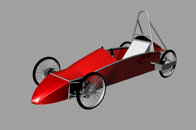
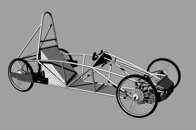
This project deserves a separate description as it is an idea born in 2019 to offer, especially to middle and high schools with a technical or scientific orientation with a technological focus, the opportunity to undertake a STEM path in the automotive sector.
We know that electric or hybrid propulsion for transport vehicles will be the near future, especially in urban environments. This proposal aims to give children and students the opportunity to understand the fundamental characteristics of an electric vehicle and, implicitly, everything related to its components.
The single-seater chassis of this vehicle has many “racing” features that allow students to make small setting up to improve its handling characteristics. Here too, the students will learn about vehicle behavior on the road by studying the basic concepts of vehicle dynamics as well as fundamental electrical engineering knowledge needed to manage the vehicle's batteries, wheel drive, and range.
The chassis is designed to be built with durable and therefore safe materials; schools or students organized into teams can participate in competitions that include regularity or endurance races that can be held either on closed circuits such as go-kart tracks or in public/private spaces closed to traffic such as parking lots or old industrial areas.
There are technical and sporting regulations for competitions.
The teaching, which includes both theoretical and practical training, will be provided free of charge to schools by an association of volunteers with specific experience in the field. Schools will be provided with a basic learning course, which can be held in school laboratories or at private institutions.
The students, organizing themselves into teams under the patronage of their schools, will have to cover the cost of the vehicle and will have technical assistance from the aforementioned organization.
The above summary outline calls for the involvement of industrial groups or companies in the electric vehicle and mechanical engineering sectors in general, or of bodies that promote electric mobility at a local or national level.
This type of initiative builds on what is already happening in Europe and beyond, with the patronage of industries in the sector but above all thanks to the educational intervention of schools.
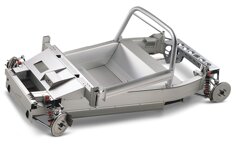

Lotus Elise chassis - Lotus Engineering
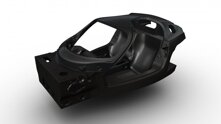
The aim of this short article is to understand exactly where the development of bonded and/or riveted aluminum chassis could lead; we know that there are at least two types of these techniques that involve assembly with elements, in both cases, tubular or extruded aluminum profiles; the other technique, probably less applied and perhaps little known, is that of using components in composite or polymeric material and that act function as connection nodes for each aluminum element, be it tubular, extruded or profiled.
In European production, Audi's commitment and production in the sector of series vehicles with aluminium bodies and chassis comes to mind, but in the sports car sector, one cannot help but mention Lotus, especially with the Elise or Evora models.
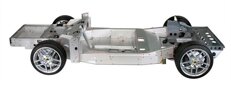
Lotus Evora chassis - Lotus Engineering
The In both cases, the use of aluminium has led to a significant reduction in weight, probably in costs, but without neglecting so-called passive safety and comfort, especially for a touring vehicle.
We know well that in the motorsport sector, chassis made of welded steel tubes are still used in many cases, arranged in such a way as to withstand tensile and compressive loads and stresses such as torsion. It is certainly a much cheaper system but with fewer performance characteristics than the same aluminium chassis.
The assembly techniques of an aluminum chassis, more specifically for the construction of a tub composed of tubular profiles and aluminum sheets, can include welding, a very particular and complex technique, or gluing the parts with epoxy resin adhesives.
The construction technique of a carbon fiber or Kevlar chassis composite material also has its advantages in terms of resistance but it is still a technique with higher costs especially if you are oriented towards small series production; in this case some important elements such as the inserts that will house the connecting parts of the engine to the frame or bolts are generally in aluminum.

IF YOU’RE AN ENTHUSIAST, A COMPANY IN THE SECTOR, AN INSTITUTION OR A PROFESSIONAL AND WOULD LIKE TO HELP ORGANIZE, PLEASE CONTACT US USING THE FORM ON THE CONTACT
Ferrari F70 chassis
THE TECHNIQUE OF NODES (CHASSIS JOINTS) IN COMPOSITE MATERIAL
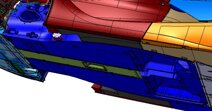
It consists of assembling tubular aluminum elements through joints made of composite or polymeric material until obtaining a tubular structure that will compose the chassis with riveted and bonded aluminum sheet panels and optimized for the creation of a monocoque on which to assemble the suspension parts and other passive safety elements.
These joints or nodes can be made in various ways including additive 3D printing with significant economic savings due to the creation of the same but with the fusion, extrusion or drawing technique.